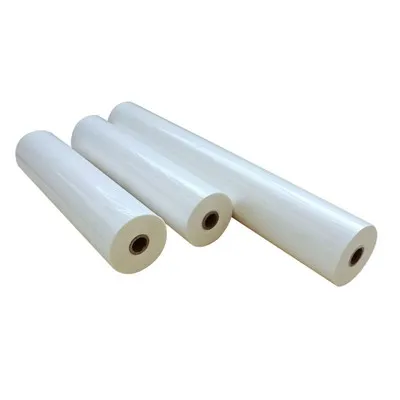
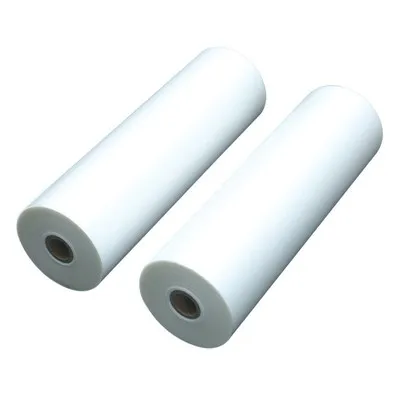
Pre-coated films consist of a substrate and an adhesive layer. The substrate is typically polyester (PET) film or biaxially oriented polypropylene (BOPP) film.
BOPP pre-coated film uses polypropylene film as the substrate and has advantages such as light weight, a density of 0.91 g/cm², good heat resistance, good chemical stability (resistant to acids, alkalis, and oils), moisture and water resistance, non-toxicity, odorless, and high transparency. Its disadvantages include poor oxygen barrier properties, susceptibility to aging under sunlight, poor low-temperature resistance, and high static electricity, requiring surface corona treatment before printing.
PET pre-coated film uses polyester film as the substrate. Polyester film has high mechanical strength, high tensile strength, high stiffness, and impact resistance. It also has good heat resistance (melting point 260℃, softening point 230~240℃) and excellent dimensional stability. Polyester film is resistant to oil and chemical corrosion, resistant to acids but not to strong alkalis, and has good gas and odor barrier properties. However, its water vapor barrier properties are not as good as polyethylene and polypropylene, and its UV transmittance is poor. The density of PET pre-coated film is approximately 1.38 g/cm³, with a tensile strength ≥200 MPa, gloss ≥95%, and high temperature resistance up to 120°C. Moisture permeability/m²/24 hours.
Pre-coated film exhibits high transparency and gloss. Its excellent physical properties include high tensile strength, tear resistance, scratch resistance, abrasion resistance, and folding resistance. Pre-coated film also possesses high temperature resistance, waterproof and moisture-proof properties, and chemical stability.
Pre-coated film is a green and environmentally friendly product; it is non-toxic, odorless, benzene-free, and harmless to the human body.