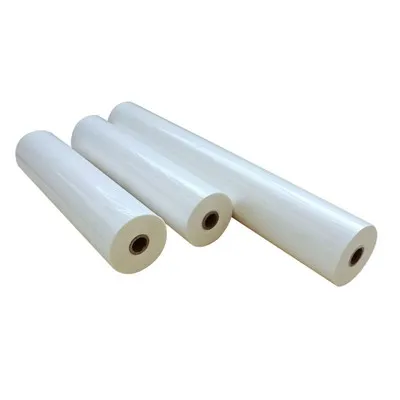
The core principle of pre-coated films lies in using adhesives such as hot melt adhesives, water-based adhesives, or pressure-sensitive adhesives to firmly bond the film to a substrate (such as paper, plastic, or metal), forming a composite structure with protective, decorative, or functional properties. The technological advantage of pre-coated films is that they eliminate the on-site adhesive application step, improving production efficiency and reducing volatile organic compound (VOC) emissions, aligning with environmental trends.
The type of pre-coated film is mainly determined by the type of adhesive, the film material, and the coating process. For example, hot melt pre-coated films achieve bonding through heating, typically with a temperature resistance range between -20℃ and 80℃, suitable for applications requiring resistance to alternating hot and cold temperatures, such as food packaging and pharmaceutical labels. Pressure-sensitive pre-coated films, on the other hand, do not require heating and are bonded directly through pressure, commonly used in fields with high operational convenience requirements, such as electronic products and automotive interiors. Regarding film materials, polyester (PET) base films offer high strength and transparency, while polyethylene (PE) base films, due to their good flexibility, are more suitable for bonding to curved or irregularly shaped surfaces.
Pre-coated films are particularly outstanding in their waterproof, dustproof, and damage-resistant properties. Taking food packaging as an example, pre-coated films can form an airtight layer, blocking oxygen and moisture and extending shelf life. In electronic product lamination, their dustproof function prevents particle intrusion, improving product reliability. During transportation, their damage-resistant design reduces the impact on internal components through cushioning. Furthermore, the pre-stretch ratio of the pre-coated film (e.g., 400%) directly affects material utilization; high-stretch ratio products can reduce film usage while maintaining strength, thus lowering costs.